Butterfly Data helps UK public sector organisations get national-scale, citizen-level data accurate, governed and connected, so you can use analytics and AI responsibly. By combining the deep expertise of our UK-based specialists with global-scale technology and innovation, we help you make every decision with confidence, knowing your data reliable and ready to drive impact.
Butterfly Data is an employee-owned, B Corp certified data consultancy and technology solutions provider. For over 20 years we have worked on some of the UK’s largest and most sensitive citizen datasets for government departments, defence, policing and health.
Our specialism is the work that has to happen before AI can be relied on, such as data quality, governance, integration and moving data off legacy systems. With those foundations in place, we build the analytics and AI that sit on top.
Design and implement scalable data platforms that enable seamless integration, automation and cloud-based operations to support modern analytics and AI solutions.
With over 20 years’ experience, our dedicated team of data scientists, engineers and technologists, familiar with secure and compliant data practices, bring unrivalled expertise, adding real value without the overhead costs associated with larger firms.
Every organisation is unique, and so is its data. We build close relationships with your team, tailoring our services to align with your business objectives and solve your challenges.
As a proud B-Corp, we use the power of data for good – partnering and collaborating with organisations that align with our core values to create a positive impact.
“The invaluable work that Butterfly Data have undertaken with a key collaborator of mine will feed directly into my work, making it both simpler and faster and enabling me to better identify data gaps. Incredibly useful. Thank you."
Digital evidence is defined as information of investigatory value that is stored or transmitted electronically. Sourced from hardware such as hard drives, mobile phones, and CCTV systems, this umbrella term spans across data artifacts including electronic mail, contact directories, communication logs, images, and audio visual recordings.
Today, the digital forensic landscape operates within a framework that is increasingly strained by the sheer volume of incoming electronic evidence. As investigators routinely seize hardware ranging from mobile devices to surveillance infrastructure, laboratories face the complex task of isolating relevant digital artifacts from overwhelming quantities of non-probative data. This persistent mismatch between laboratory resources and the scale of seized media has resulted in a staggering national backlog, with wait times now routinely stretching past the 12-month mark for over 20,000 queued devices.
The Systemic Bottlenecks in Forensic Processing
As highlighted by the NPCC , over 90% of reported offences now feature a digital component. However, reflecting on the seizure process, the initial collection of this evidence is predominantly conducted by frontline officers rather than Subject Matter Experts (SMEs). This practice generates unnecessary processing delays during intake, as un-triaged devices are submitted in bulk to specialised laboratories.
Delving deeper into the issue, police forces face severe SME retention deficits, outdated technical infrastructure, and complex legal frameworks where administrative authorisation timelines frequently exceed execution times. Qualified specialists are routinely overwhelmed by manual, repetitive extraction tasks, leading to workload fatigue and high staff turnover. These internal pressure points are made worse by a rising wave of external cyber threats, with national data showing that 19% of UK businesses and 14% of charities fall victim to cybercrime each year. As capabilities lag behind criminal technology, law enforcement requires systemic overhauls, including centralised national digital platforms and dedicated AI centers, to manage the expanding workload efficiently.
A Technical Roadmap for Digital Forensics
Addressing this force-wide bottleneck requires a fundamental paradigm shift toward automated triage, edge processing, and a standardised digital data architecture. Data science and automated engineering present clear opportunities to transform this crisis into an efficient, scalable pipeline:
Automation and AI Integration
Integrating artificial intelligence within the primary digital data sweeping phase, specifically utilising automated text extraction and computer vision algorithms, allows systems to automatically flag incriminating data artifacts. Image recognition models and natural language processing can scan raw media for specific keywords, visual indicators, or other needed material. While human-in-the-loop oversight remains mandatory for court admissibility, automating this initial pass dramatically minimises manual man-hours.
Standardised Workflows and Analytics
Fragmented workflows across different forces create inconsistent outcomes and difficulty to share resources across the different forces. Implementing standardised, automated ingestion scripts ensures evidence is systematically categorised, sorted, and routed to the correct department without continuous manual intervention. Furthermore, deploying force-wide analytical software allows investigators to automatically cross-reference identifiers, phone numbers, nicknames, and digital signatures across separate cases, uncovering hidden connections that could otherwise be missed.
Targeted Upskilling
Technology must be supported by foundational operational skills. Establishing core digital etiquette across all frontline staff ensures evidence integrity from the moment of seizure. Embedding tactical "Digital Champions" within standard investigative units bridges the knowledge gap between frontline officers and expert tech laboratories
Conclusion
Ultimately, resolving the digital forensics crisis requires closing the gap between raw data collection and actionable intelligence. By modernising legacy infrastructure, standardising ingestion pipelines, and deploying automated triage tools, police forces can eliminate processing backlogs, support frontline personnel, and accelerate the administration of justice.
Large-scale data migration is one of the most common reasons public sector AI projects stall, as moving to a modern cloud platform does not make data AI-ready on its own. What makes the difference is the governance work done before, during and after the move.
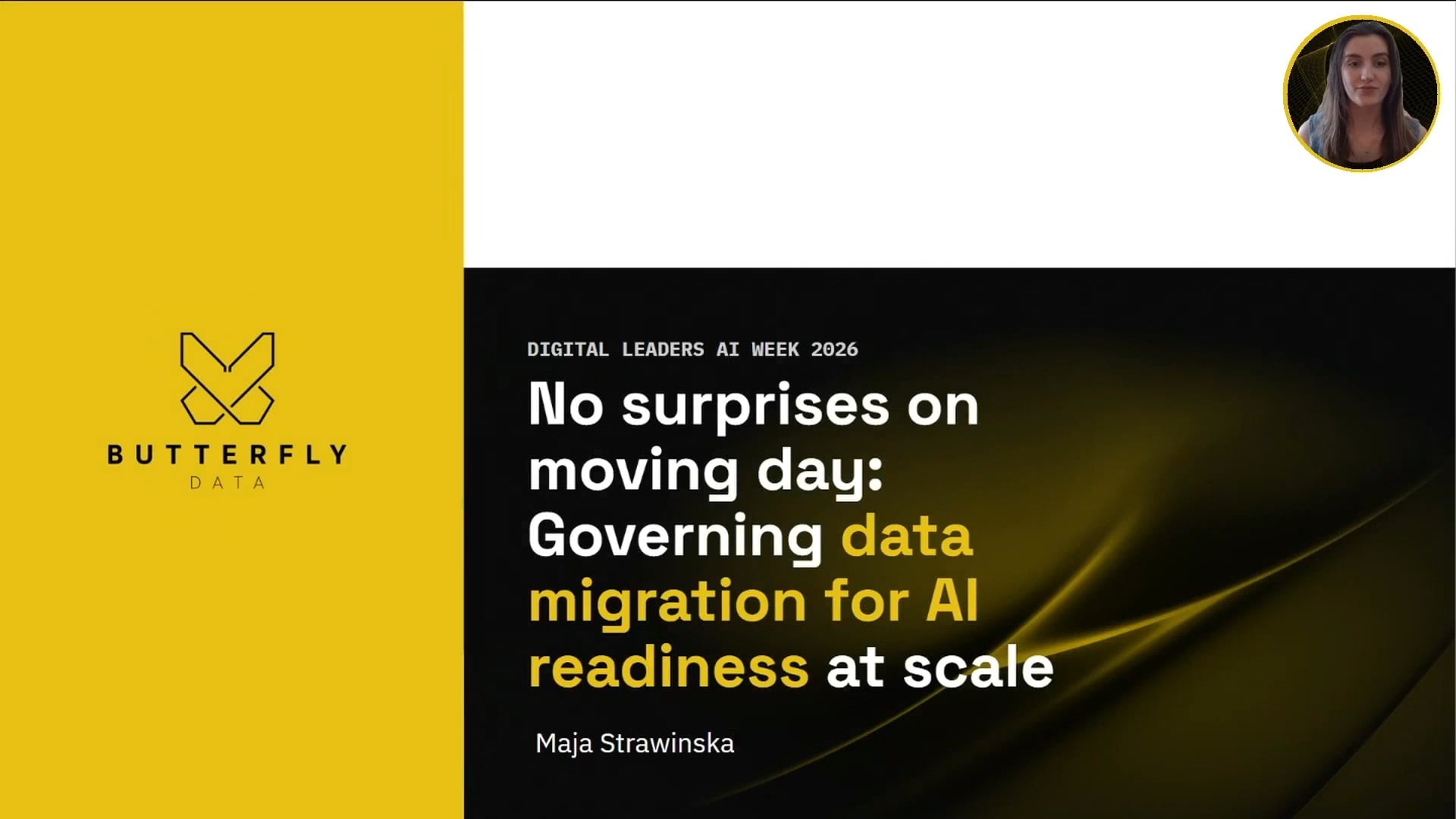
In this session from Digital Leaders AI Week 2026, our data scientist and engineer Maja Strawinska uses moving house as a way to explain how to plan and govern a migration of national-scale, citizen-level data. In a similar session to that delivered earlier in the year at the Public Sector Connect Data and AI Summit, she covers why organisations move off legacy systems, how to choose an approach using the 6 R’s, how to decide which data to leave behind, why metadata matters, the security and approvals needed and how to bring stakeholders with you. She also explains the 1-10-100 rule: fixing data problems at source costs a fraction of correcting them later, and far less than dealing with a failed migration.
The session runs for around 17 minutes and is aimed at digital, data and technology leaders responsible for legacy modernisation or AI readiness. You can watch it below.
For the evidence behind the talk, read our whitepaper, The Hidden Cost of Legacy Data Systems in UK Public Services.
Book a free discovery call
Find out how Butterfly Data can help your organisation understand its legacy risk and build a credible path to modernisation.
Frequently asked questions
What are the 6 R’s of data migration?
The 6 R’s are the main options for moving a system. Retain means leaving it where it is. Rehost is a straight lift and shift. Replatform is a lift and shift with some changes on the way. Refactor reworks the system to suit the new platform. Rebuild creates it again from scratch. Retire switches the old system off.
What is ROT data?
ROT stands for redundant, obsolete and trivial data. Redundant data includes duplicate records of the same citizen held in different legacy systems. Obsolete data has passed its legal retention period. Trivial data, such as system logs and temporary files, adds no value to future services. Identifying ROT data during discovery means it can be left behind rather than migrated.
What is the 1-10-100 rule of data quality?
The rule describes how the cost of a data problem grows the later it is found. Preventing a problem through validation and labelling before migration costs 1. Correcting it on inspection costs 10. Dealing with a failure after go-live, such as system downtime, broken AI models or interrupted services, costs 100.
Why does data migration matter for AI readiness?
AI is only as good as the data it is given. Moving to a cloud platform does not make data AI-ready on its own. Data needs to be clean, validated, well labelled with metadata and interoperable, with consistent pipelines and clear governance, before it can reliably support AI and machine learning.
Why is metadata important in a data migration?
Metadata tells you what the data is, where it came from and who is allowed to see it. Defining schemas and data dictionaries before the move means every dataset has a clear place in the new environment and can be found, governed and used from day one.
What is a cutover strategy?
Cutover is the point at which services switch from the old system to the new one. It follows formal sign-off from stakeholders and the Design Authority. A good cutover strategy maps every dependency in advance so users, access controls and business processes move across without breaking downstream services.
Video transcript:
Hello all, and welcome to No Surprises on Moving Day, which is all about governing data migration at scale, where I take you through the steps to make your migration stress-free in a bite-sized way.
Firstly, let’s get to know me and Butterfly Data. I’m a data scientist and data engineer, experienced across multiple government agencies, with two years at Butterfly Data under my belt. In my own time, I’m a proud Scouts leader and adventurer. At Butterfly Data, we are SMEs in dealing with national-scale, citizen-level data across the public sector, with expertise in data quality, visualisation, insights, migration, engineering, data science, and much, much more, all about data.
Let me introduce the flow of this presentation. First, I’m going to introduce you to the house move analogy, then the migration process as a house move. Next, the new home and the foundations that we need to have there before we move.
So, why use an analogy? Using an analogy to explain complex technical things makes these ideas a lot more digestible and relatable. Just as you wouldn’t move house without a plan, you don’t want that experience of missing that box, do you? You can’t necessarily migrate data at scale without a governed moving list. In the public sector, we manage millions of citizen records. The moving day stakes are so much higher than just a broken lamp. The old home is our legacy data estates, technical debt, the clutter. The new home represents the modern cloud platforms available to us.
You may be thinking, why move now? There may be [many] reasons to move your home, but in terms of migrations, there are three overarching reasons. Our legacy systems tend to be high maintenance. They’re poorly maintained. We spend thousands fixing them. There may be flood risks, increasing structural damage. There may be leaks, water damage. The electricity might need redoing. In terms of migration, external factors tend to force the move. So the legacy hardware could be reaching end of life. There could be security vulnerabilities that are piling on. Compliance regulations could be shifting, meaning we no longer comply with them. And vendor licensing costs could just become too much.
Another reason is that our house could be too small. In our first home, we may have those overflowing closets, stuff from our trips tucked away in the hallways. In reality, the floor plan just doesn’t support our growing family. So thinking about migration, there are operational constraints. Databases may hit physical storage limits. Queries may crawl during peak traffic hours. And the rigid legacy architecture may just not be able to digest the large volumes we’re getting from modern-day systems.
And our final reason is new tech. In the new home, we might have the smart features, the solar panels, the automated lights when we walk through the door. We might have electric charging for our vehicle outside our doorstep. So in the migration, what does this mean? These are the feature upgrades, upgrades into cloud-native perks. We have real-time streaming analytics. We may have automated disaster recovery, serverless scaling, and plug-and-play AI and machine learning integrations, which in reality we just can’t do on our legacy systems.
Now, I’m going to guide you through the house move in the migration process.
When assessing our options, we have to ask ourselves, what do we need? Do we need to build a new home from scratch? Yes, that would provide us a bespoke platform, but places the entire burden of maintenance just on our shoulders. Or can we move to the apartment block, the cloud? In the public sector, the apartment block is often the more governed and scalable choice.
When we discuss migration, we talk about the six R’s. And let’s just quickly run through what each one of those means. A refactor is remodelling the new house. A rebuild is a purpose-built house. If we retire, we demolish the old house. If we retain, we do nothing and just become a squatter. If we rehost, this is our lift and shift approach. And if we replatform, we are lifting and shifting with new furniture.
So how do we decide what to pack? We need to do a check and assess what we currently have. Do we need to take the bust bike tyre in the garage to the new home? Or can we recycle it before we get there? Discovery is a very vital part of migration. During this time, we identify all that we have and create our do-not-pack list of ROT data. So our redundant data, our duplicates of the same citizen across different legacy silos. Our obsolete data is data that might have surpassed its legal retention period. Trivial data is system logs or temporary files that add no value to the future of the digital services.
Now, what do we want to take? Clean and validated, accurate data that is up to date, with information that can be trusted. We want it to be governed, data with clean lineage and ownership, the labelled boxes. And we also want to be able to plug our data into AI models straight away. So it needs to be interoperable.
You may be wondering what some of the common mistakes of discovery might be. The lift and shift approach can cause pain much further down the line. If you move the clutter from your old attic into a brand new smart home, all you have done is pay to store rubbish in a more expensive location. Governance guides our do-not-pack and must-take lists. It’s a filter that ensures only the high-quality, AI-ready data makes it into our new environment.
So let’s talk about labelling our boxes. If we don’t label them correctly and just call it “stuff”, how will we be able to find it in the new home? Will you remember what stuff you put in there a month ago, two months ago? We’re really risking important records ending up in the garage while some of our junk might just take up space in the kitchen. So the label, the metadata, tells us what the data is, where it came from, and who’s allowed to see it.
In order to take this correct action, there are a few things that we need to do. We need to define our schemas: create the floor plan for the new house so every box has a designated spot to end up at. We want to create data dictionaries: the inventory list that ensures the living room in the old house matches the living room in the new house. And finally, we want to ensure strong governance, ensuring our data is not just moved safely but ready to power the next generation of our digital services. We don’t want that nightmare where we have to open 20 boxes to find our kettle, and this is just how we make sure of that within the data world.
So next I’m going to talk you through our building regulations. Are there any rules that we have to abide by in the new world? One of them is soundproofing. We don’t want a home where we can hear the neighbour’s 4am alarm. We want the data to be isolated on private or public cloud, preventing data leakage. We need to ensure encryption at rest and in motion.
We also want access control. Does every member of our family or friend group need a key to our home? Can we provide temporary access to the home to water the plants during summer when we may be on leave? So when talking about this, it’s all about identity and network security: role-based access control, least privilege, blast radius and zero tolerance. Does everyone need a key to every single room?
And finally, let’s talk about our structural integrity. Have we had the house surveyed? Are all the approvals in place? We need approvals from the Design Authority. We need approvals from data governance and other stakeholders, and we need to make sure that we have our data sharing agreement in place. [And to this,] there is a little routine: authorise, approve and iterate. We need to make sure we do all these steps and repeat and repeat in order to get the best outcomes.
Next, I’m going to talk briefly about the family and our stakeholders. In every large-scale public sector project, there is a family of stakeholders who are deeply sentimental about their legacy system. They might have spent 20 years learning the quirks of that specific database. So what is the old house? The old house is comfort. The legacy systems are comfortable, just like your own home. People know their quirks, know that wonky step and know how not to trip walking that way. But the new home feels different. The light switches are in new places. The heating is automated. The spaces feel bigger, possibly empty.
So to do this move correctly, we need to move the family, not just the furniture. We need to address the [new config], our knowledge that the new home feels different, and make sure that they know that. We need to manage the human impact. We don’t just show them around the new home. We want to involve the family in the architectural phase, making sure they feel part of the team at every step. Next is the training. We need to help the workforce understand that the smart home features and automation aren’t there to replace them, but to make the housework, or data processing, easier, smoother and more streamlined.
Now we are in our new home. So we need to talk about preparing the foundations for AI. Just like you can’t install a smart security system if a house doesn’t have electricity, you can’t run a large language model if your data is unstructured and unverified. You don’t just want to move for the sake of it. You move to make room for new things: AI, machine learning, automation.
You need to make sure that the flow of water is there, so the data pipelines must be consistent and clean. If there’s muddy water at the source, the smart fridge might break. We also want to ensure high-quality input. AI is only as good as the data it’s fed. You’ll hear “garbage in, garbage out” referred to quite a lot in the world of AI. We also need to make sure that ethical governance is set. So, are the smart home sensors and AI algorithms unbiased and secure? We also need operational readiness, moving from legacy batch processes into real-time digital services.
So you may come across something called the snagging list, and this is basically prevention over reconstruction. Fixing a foundation after a house is built costs 10 times more than surveying the land before breaking ground. Core data governance works the same way. It isn’t a delay, it’s a 10 times cost-saving measure.
So I’m going to break this down for you. It follows a 1-10-100 rule. £1 is prevention: validating the schemas, labelling the data and enforcing hygiene before moving. £10 represents correction: paying the specialists on inspection day to track down the broken APIs or the unmapped fields. And £100 represents failure: the system downtime, broken AI models and interrupted services post-migration.
In [house] building, a snag may be a loose tile. In data, it’s a corrupted record. Without early governance, your snagging list becomes a structural failure. Fixing one downstream defect causes three more to pop up in analytics and AI models. In government, a failed migration means citizens lose access to vital services. Governance ensures moving day is quiet and non-eventful. Modern cloud platforms allow teams to test and learn on [sample] datasets, validating pipelines in a sandbox before reaching the point of no return. It’s important: spending 1% upfront on pre-migration checks avoids 100% of a rebuild later, protecting public funds from steep premiums and a lot of technical debt.
Fantastic. Now we’re going to discuss moving in. Firstly, I want to talk about some cutover strategies. So when do we exchange contracts? This is the point of no return. The cutover strategy is the digital equivalent of exchanging contracts and officially changing your address. This is the service transition, the point of no return. Formal Design Authority approval and stakeholder sign-offs validate that the new environment is ready, triggering the live cutover with full governance backing.
Redirecting the flow: remapping the users and processes. Changing your house address requires updating every single service and utility provider to maintain continuity. In a data migration, this means identifying all dependencies to seamlessly remap users, access controls and business workflows to the new solution. Mapping these operational pathways before go-live ensures that daily processes transition cleanly without breaking any downstream operations.
I’m going to take you through a quick summary now. Decluttering and data preparation: audit the attic. Use data discovery to leave the ROT data behind, and separate our high-value operational data in the living room from compliance archives in the attic. We need to label the boxes: implement rich metadata up front so the new environment is organised, searchable and governance-ready from day one. We need to check the pipes: validate the APIs, the pipelines and the underlying architecture to guarantee structural integrity before go-live. Then we need to hand over the keys: use active change management and thorough documentation to transition our stakeholders, our family, smoothly into the new system. We need to have an elastic infrastructure. Unlike physical houses, cloud environments leverage automation to instantly build temporary space for spikes, auto-scale on demand, and tear down when no longer needed.
I just want you to be aware, this will be live by the time this presentation is up. It’s key findings from Rewiring the State, DSIT’s State of Digital Government Review and more, all in one paper. It’s all about the hidden cost of legacy data systems in UK public services.
Through projects, we’re constantly helping clients navigate change, make informed decisions and solve complex problems. To do this effectively, we need to be continuously learning ourselves.
That’s why I’ve launched the Butterfly Data book club.
At first glance, a book club might seem like a simple social activity: read a book, share ideas and have a discussion. But the real aim is much bigger than that. It’s about creating a culture where learning is intentionally built into our work, collaboration extends beyond project teams and new ideas are translated into practical actions that benefit both our people and our clients.
So, why a book club?
The pace of change across technology, data and consulting means that standing still isn't really an option. New ideas emerge constantly and some of the most valuable lessons come from outside our immediate projects.
A book club gives us dedicated time to explore those ideas together.
Rather than learning in isolation, we can:
Discover new ways of thinking
Challenge our assumptions
Learn from colleagues with different backgrounds and experiences
Translate concepts from books into practical actions for client work
Create meaningful conversations across teams and projects
The objective isn't simply to finish a book. It's to create opportunities for reflection, discussion and application.
Our current book is Superforecasting by Philip Tetlock and Dan Gardner. This book explores why some people consistently make better predictions than others and identifies the habits, behaviours and thought processes that improve decision making in uncertain situations.
Through participating in the book club, I hope colleagues will:
Learn something new
Hear different perspectives
Develop professionally and personally
Build connections with people they may not usually work with
Gain practical ideas they can apply in their projects and careers
We’ve built the club around a simple philosophy:
Read. Reflect. Discuss. Apply.
Because learning has the greatest impact when it leads to action.
Looking ahead
My ambition is for the book club to become more than a regular meeting. I hope it becomes a space where curiosity is encouraged, diverse viewpoints are welcomed and learning becomes a shared experience.
The best organisations don't just deliver great work. They create environments where people continue to grow, challenge themselves and learn from one another. If this book club helps even a few people discover new ideas, build new connections or think a little differently, it will be a success.
Because in our industry, the organisations that learn fastest are often the ones that create the most value.
Ready to transform your data?
Book a free discovery call to explore how our tailored data solutions can help you manage complex datasets, gain actionable insights and drive measurable results.

.svg)
.svg)
.svg)

.svg)
.svg)
.svg)
.svg)










.jpg)
.jpg)


%20(26).png)




%20(25).png)
.jpg)