Build trust with data quality, governance and AI-ready foundations
Butterfly Data provides data quality, governance and privacy services to organisations across the UK public and private sectors. We help complex organisations — including central government, defence, healthcare and finance — assess, improve and sustain the accuracy, consistency and compliance of their data. Our services are aligned to DAMA, the UK Government Data Quality Framework and UK GDPR and are delivered by Certified Data Management Professionals (CDMP).

Why data quality and governance matter
Trustworthy data is the foundation of effective decision-making, regulatory compliance and AI-ready data foundations. This is relevant whether you operate at national scale, across complex enterprise environments, or manage large volumes of sensitive citizen or customer data. According to DAMA, organisations lose between 10% and 30% of revenue managing poor-quality data, demonstrating how weak data practices undermine performance, trust and long-term value.
The cost of poor data quality at scale
When data quality, governance or privacy break down, confidence in data is lost across departments, functions and partner ecosystems. This creates risk, slows innovation, and limits the safe adoption of AI. Scalable data governance frameworks, aligned to recognised industry and regulatory standards, are essential to ensure data is consistent and fit for purpose, especially where data is shared across organisations or used to support high-impact services like in the public sector.
By prioritising trust in data, organisations can improve data quality, manage risk effectively and establish strong data foundations for further data projects and AI, enabling innovation and confident, evidence-based decision-making.
.png)
Turning data governance into AI readiness
Recognising poor data quality or unclear accountability is only the first step. We help organisations move beyond fragmented, reactive fixes by designing clear data operating models, data ownership models, and data stewardship frameworks that work across both departmental and cross-functional environments.
Implementing cross-functional data governance
Our approach supports organisations operating at scale, often with complex legacy systems, diverse data sources, and sensitive citizen or customer data - where consistency, transparency, and accountability are critical. We implement practical data governance frameworks aligned with DAMA and recognised best practice, combining real-time data quality monitoring with clearly defined stewardship roles and governance controls.
The result is reliable, high-quality data that reduces operational and regulatory risk while improving trust across the organisation. These foundations support data quality and AI readiness, enable structured AI readiness assessments, and provide the governance needed for AI risk management. With trusted data in place, organisations can adopt AI and advanced analytics responsibly, unlocking insight and value while maintaining confidence, compliance and public or customer trust.
.png)
Get your free online data maturity assessment
Complete a short questionnaire and receive a personalised data maturity profile. You'll learn how well your organisation performs across six key areas of data maturity and which capability gaps are worth focusing on.
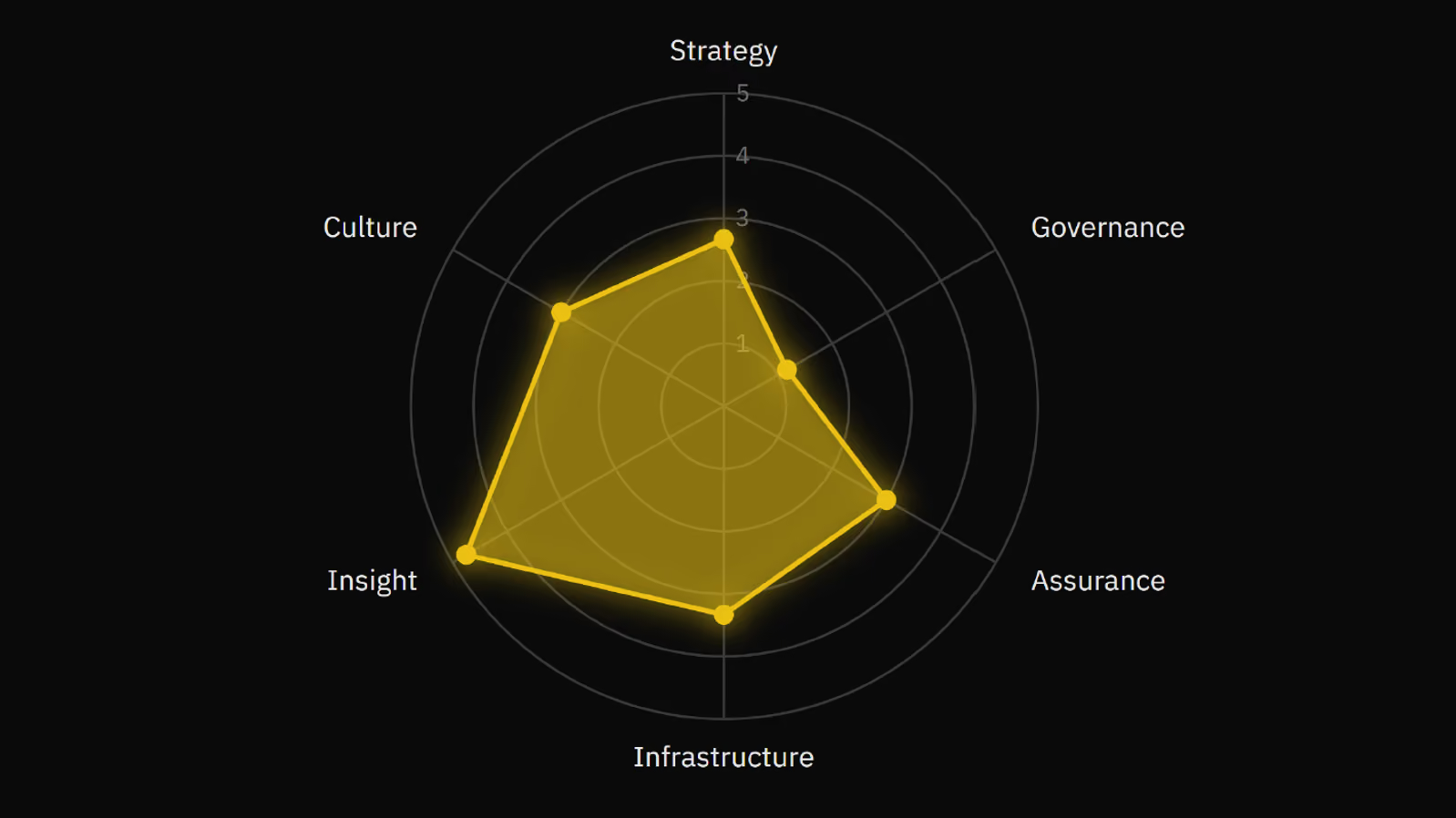
Expert data governance, data quality and data privacy services
Strengthen data quality and AI readiness across the data lifecycle
High-quality data is a critical foundation for AI readiness. Data quality measures both the intrinsic value of data, the degree to which it is complete, accurate and consistent, and its organisational value, defined by how effectively it delivers intended outcomes. Strong data quality control and assurance are essential to successful data management and often determine whether data and AI-based initiatives succeed or fail.
Our data quality services are aligned with DAMA and the Government Data Quality Framework, supporting organisations to embed robust data quality principles, establish a sustainable data quality culture and manage data quality consistently across the full data lifecycle. We help ensure your data is fit for purpose, trusted by users and ready to support advanced analytics and AI use cases.
We work with you to maximise the accuracy, consistency and reliability of your data through the design, planning and execution of sustainable data quality strategies. This includes assessing key data quality dimensions, measuring data against agreed standards and identifying issues early so they can be addressed at source. In line with the Government Data Quality Framework, we support root cause analysis, the development of targeted data quality action plans and clear communication of data quality to users and stakeholders.
Our services can be delivered using your existing tooling or by supporting the implementation of new data quality capabilities. These include data profiling, validation, cleansing, matching, monitoring and remediation, as well as the detection of orphaned records and outliers. We also support investigator processes, metadata management, data quality reporting and tokenisation to protect sensitive information. Together, these capabilities reduce risk, improve trust and enable confident, evidence-based decision-making while strengthening your organisation’s readiness for AI.
Establish robust data governance and stewardship across your organisation
We help organisations implement comprehensive departmental and cross-departmental data governance frameworks that improve data quality, manage risk, and ensure regulatory compliance. Fully aligned with the UK Data Management Association (DAMA) and the UK National Data Strategy, our approach supports compliance with legislation such as GDPR and the Data Protection Act (DPA), giving you confidence in both security and accountability.
Working closely with key stakeholders, we define data ownership models and assign data stewardship responsibilities, creating clear accountability for all information assets. This ensures that data is consistently managed, protected, and made available to drive ethical innovation and informed decision-making. Our frameworks are designed for public and private sector readiness, bridging skills gaps often found in large organisations with complex data landscapes.
Our services enhance data integrity and quality by embedding continuous assurance practices and validation checks, ensuring information is accurate, complete and reliable. We implement role-based access control (RBAC) and least-privilege policies to control access to sensitive data, while privacy-enhancing techniques, such as masking, redaction, or synthetic data, enable safe sharing and collaboration without compromising personally identifiable information (PII).
We provide full data lineage mapping to track the journey of your data from source to target, enabling root-cause analysis, transparency and accountability. Real-time dashboards and governance metrics allow ongoing monitoring of data health, policy adherence, and compliance, supporting better decision-making across departments. By embedding clear data stewardship roles, enforceable policies and standards, we encourage a culture of continuous improvement and responsibility for data quality.
Our frameworks are scalable and future-proof, tailored to organisations of all sizes and adaptable to evolving business processes, customer services and technology landscapes. Delivered through agile methodologies, our projects are outcome-focused, ensuring practical, evidence-based solutions that improve accessibility, reliability and security across your organisation.
With this integrated approach, organisations gain trusted, high-quality data, a robust compliance posture, and the governance structures needed to support both departmental and cross-departmental data management, unlocking the full value of their information assets.
Safeguard data privacy while enabling AI and innovation
Delivered by Certified Data Management Professionals (CDMP)®, our data protection and privacy services help organisations balance regulatory compliance with operational efficiency. We design and implement future-proof solutions that support complex GDPR obligations, including automated data retention processes, comprehensive data lineage tracking, and management of Subject Access Requests (SAR) and Data Protection Impact Assessments (DPIA).
Our approach embeds privacy-focused data governance, ensuring data security, compliance, auditing and quality are integrated into everyday operations. By implementing role-based access control (RBAC), encryption and other security measures, we minimise exposure risk while maintaining operational agility. We help organisations run effective data solutions that adhere to data minimisation principles, limiting the processing of personally identifiable information (PII) and fostering trust among stakeholders.
We enhance data quality and integrity through tailored solutions that validate, cleanse and monitor sensitive information, reducing errors and risk in PII handling. Comprehensive data lineage and entity resolution provide a full view of data flows, transformations and subject-level connections across the organisation, supporting auditability, compliance and simplified SAR management. Automated data retention pipelines reduce human error and help maintain consistent, compliant practices.
To enable safe innovation and adoption of advanced technologies such as AI, we implement synthetic data, dynamic masking and redaction strategies. These approaches allow your teams to collaborate and explore new capabilities while safeguarding sensitive data, maintaining trust and minimising bias. By combining privacy protection with operational efficiency, we turn compliance into a business enabler, ensuring your organisation can innovate confidently without compromising data integrity.
Utilising agile methodologies, we tailor end-to-end privacy strategies to your specific technology landscape, delivering verifiable, high-quality data systems that protect sensitive information while supporting ethical, data-driven innovation.
Build an AI-ready data foundation with a clear roadmap to data maturity
Our data maturity assessment and AI readiness assessment provide a structured, evidence-based evaluation of your organisation’s data capability, maturity and readiness for AI adoption. We assess people, processes, technology and governance to determine how prepared your data landscape is to support advanced analytics, automation and AI-driven decision-making.
Using recognised frameworks, including data maturity models and industry benchmarks aligned with the UK Data Management Association (DAMA) and the UK National Data Strategy, we evaluate your ability to extract value from data while managing risk, compliance and governance obligations. As organisations pursue digital transformation and AI initiatives, gaps in data capability often prevent progress and limit return on investment.
Our assessment identifies current strengths, weaknesses and priority improvement areas across data practices, platforms and operating models. The outcome is a clear baseline of your current state, alongside a prioritised roadmap to improved data maturity and AI-ready data, enabling targeted investment, enhanced data literacy and stronger regulatory alignment.
To get started, we've developed a short, online self-assessment to help you understand how your organisation is doing across six key dimensions of data maturity.
← Select a solution or service from the list
Heading 1
Heading 2
Heading 3
Heading 4
Heading 5
Heading 6
Lorem ipsum dolor sit amet, consectetur adipiscing elit, sed do eiusmod tempor incididunt ut labore et dolore magna aliqua. Ut enim ad minim veniam, quis nostrud exercitation ullamco laboris nisi ut aliquip ex ea commodo consequat. Duis aute irure dolor in reprehenderit in voluptate velit esse cillum dolore eu fugiat nulla pariatur.
Block quote
Ordered list
- Item 1
- Item 2
- Item 3
Unordered list
- Item A
- Item B
- Item C
Bold text
Emphasis
Superscript
Subscript
Benefits of strong data quality and governance frameworks
Make confident decisions based on validated data
Accurate, complete, and validated data provides a reliable foundation for confident, timely decisions across your organisation.
Identify and resolve root causes of data issues
Identify and resolve root causes of data issues with real-time profiling and lineage tracking for enterprise data quality improvement.
Protect against data loss and unauthorised access
Robust controls and automated protections reduce risks, keeping your data secure throughout its lifecycle.
Build stakeholder confidence with care and accountability
Clear ownership and transparent practices build trust with customers, regulators, and partners alike.
Boost efficiency by eliminating errors
Automated validation and matching remove redundancies, cutting rework and freeing teams to focus on value.
Ensure consistent data across the organisation
Aligned standards and shared rules create one trusted version of truth for seamless collaboration and decisions.
Enable AI, automation and growth with quality data
Clean, high-quality, and well-governed data unlocks the full potential of AI, advanced analytics, and digital transformation.
Establish a scalable foundation for future compliance
Flexible governance and privacy frameworks grow with you, easing compliance and future-proofing your data.
WHITEPAPER
What does good data look like?
In our whitepaper, we explore the critical importance of high-quality data, identify the moments when data quality has the greatest impact, clarify who holds responsibility for maintaining it, and outline practical strategies for enhancing it going forward.

Building better data solutions with world-class platforms
We deliver faster, smarter, and more dependable data solutions by partnering with global technology leaders like SAS, Snowflake, Databricks, Google Cloud, Microsoft, and others, while staying technology-agnostic to ensure the right solution for your unique needs.
.svg)
Success stories


%20(1)%20(1).jpg)
Your questions about data, analytics, and AI
Our FAQs provide clear, practical answers to help you understand how Butterfly Data can turn your data into actionable insights, streamline your operations, and drive smarter business decisions.
What data services does Butterfly Data offer?
Butterfly Data delivers end-to-end data services that help organisations in both the public and private sectors make informed, evidence-based decisions. Our expertise covers AI and machine learning, data quality management, data engineering and analytics and visualisation. We provide tailored solutions to turn raw data into trusted insights, supporting operational efficiency, strategic planning and innovation.
How can AI and data science benefit my organisation?
AI and data science enable organisations to analyse complex datasets, predict trends and automate critical processes. In the public sector, this supports policy evaluation, resource allocation and service optimisation. In private organisations, it improves operational efficiency, risk management and customer insight. Our team develops practical, scalable models that integrate seamlessly with existing systems while adhering to governance and compliance requirements.
Why is data quality important?
Reliable, high-quality data is essential for accurate reporting, policy-making and operational decisions. Poor data can lead to inefficiencies, compliance risks, or flawed analysis. Our data quality services cleanse, validate and enrich your datasets, ensuring they are consistent, complete and trustworthy. We also implement monitoring frameworks to maintain data integrity over time.
What is data engineering and how does it help?
Data engineering involves designing and building the infrastructure and pipelines that make data usable and actionable. We help organisations integrate diverse data sources, transform raw datasets and create robust systems that support analytics, reporting and AI applications. This ensures that decision-makers have timely, accurate information while maintaining secure, compliant data environments.
How do I visualise and use my data effectively?
Data visualisation turns complex information into clear, actionable insights. We create interactive dashboards, reports and visual tools tailored to your organisation’s goals, helping teams monitor performance, track KPIs and communicate insights effectively. For public sector organisations, this supports transparency and evidence-based decisions; for private organisations, it drives operational efficiency and strategic planning.
Still have questions?
Our experts are here to help you solve your data challenges – great and small.
Ready to transform your data?
Book your free discovery call and find out how our bespoke data services and solutions could help you uncover untapped potential and maximise ROI.